The force of blood and soil
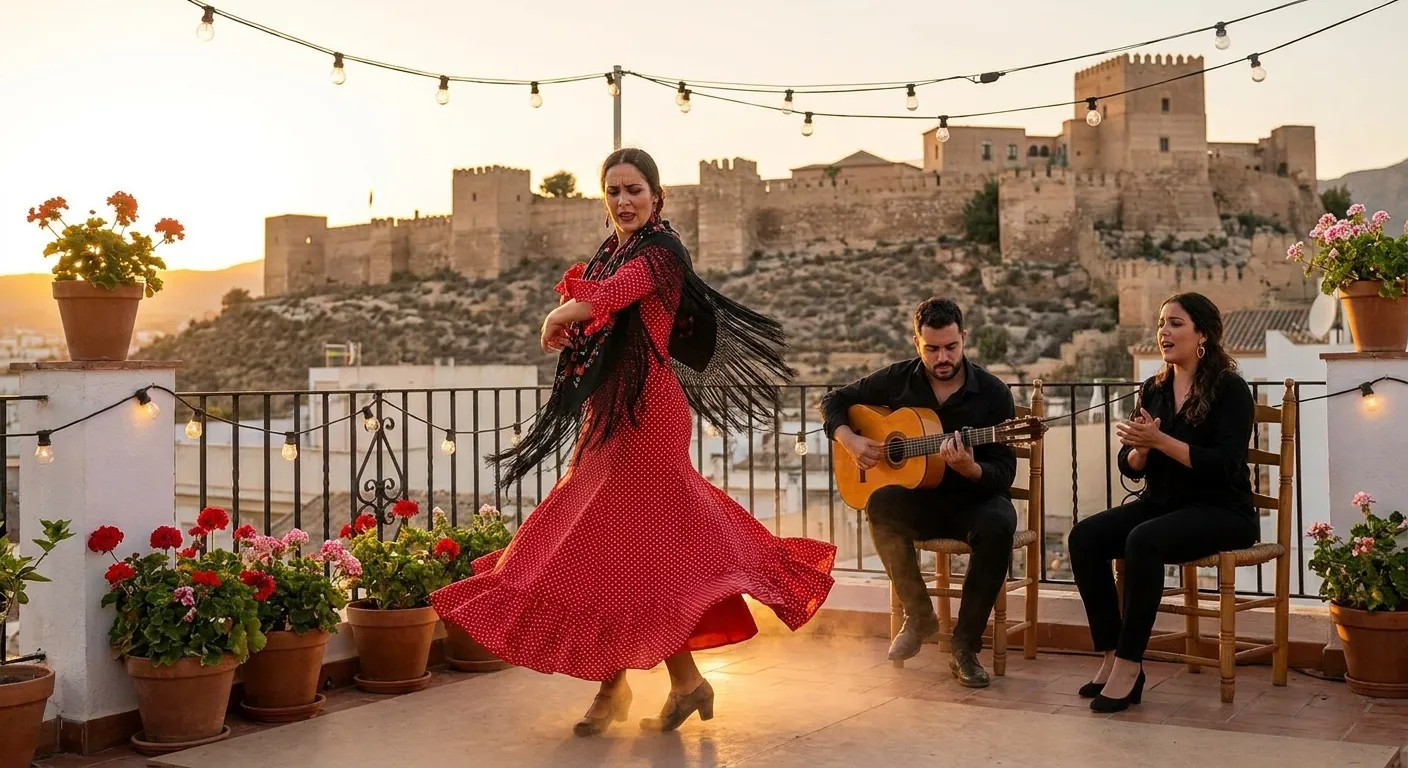
In Almería, flamenco is not learned from books: it is breathed in the salty air of the Medina and passed from house to house in La Chanca, the cave-house neighbourhood perched below the Alcazaba. It is one of the homes of the cantes de Levante, those mining songs that grew in the shadow of the lead mines.
Far from stages built for tourists, here flamenco is raw, stripped bare. A guitar, a broken voice and the muffled beat of palms on wood.
The Peña Flamenca El Taranto, founded in 1963 and housed in the aljibes de Jairán (Calle Tenor Iribarne, 20), has for decades been a benchmark of this purity. These 11th-century water cisterns, built by Jairán, first king of the taifa of Almería, today shelter song instead of water beneath their vaults.
The Legacy of the Dance
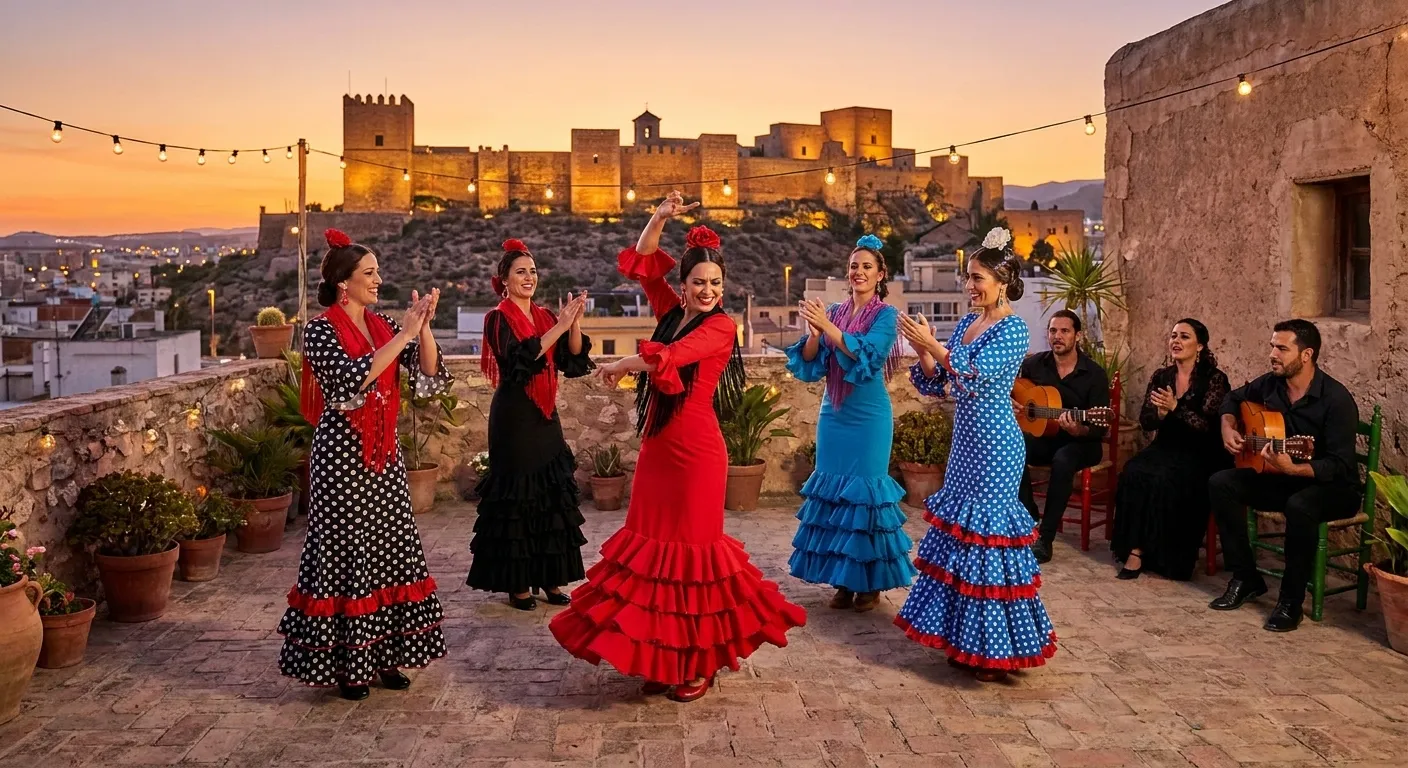
For those who want to feel the floor vibrate beneath their own feet, Almería keeps a very active flamenco life. Since 1972 the Peña El Taranto has held its Semana Flamenca, an event that has brought much of the great names of song and dance through its aljibes.
Flamenco is not just a performance: it is a language of the body, cultivated with patience. Anyone who wants to learn it will find academies in the city where the rhythm is worked step by step.
Escuela de Flamenco Chelo Ruiz
The absolute reference in Almería for learning pure flamenco. A vibrant academy that trains the talents of tomorrow in the heart of the city.
📍 Calle Montenegro, 8, 04008 Almería
📞 +34 658 87 82 97
The flamenco of Almería stands out for its sobriety and its depth. Unlike the more festive styles, here the deep "quejío" and the dramatic silence take centre stage. Its songs were born in the lead mines of the province, between the Sierra de Gádor and the Cuevas del Almanzora basin, hence their name of mining songs.
It is worth telling apart two siblings. The taranta is a free song, with no fixed rhythm: it is not danced, it is listened to. The taranto, on the other hand, has a two-by-four rhythm and is indeed danced. That danceable version was fixed by Carmen Amaya around the 1940s, and the singer Fosforito popularised it from the 1950s. It was Fosforito himself who advised the Almería club to take the name of the song of the land: El Taranto.
The verses speak of what they had close at hand: love, the danger of the pit, the hardship of working underground. Today that legacy lives on in the tablaos and flamenco clubs, where each heel-stamp rings out like an echo of that history.
"Flamenco is a philosophy, a way of thinking and feeling of an entire people."