5,000 years of History
On a spur between the Huéchar ravine and the river Andarax, in the municipality of Santa Fe de Mondújar and some twenty kilometres from the sea, lies Los Millares. Between 3200 and 2200 BC, during the Chalcolithic or Copper Age, it became one of the largest and most organised settlements in western Europe.
The enclosure was protected by four lines of concentric walls, reinforced with towers and bastions. Beyond them, set on both sides of the ravine, a network of thirteen forts watched over the territory and the access routes. Inside lived copper craftsmen, potters and farmers: the houses, circular in shape, were grouped beside workshops where ore brought from the nearby sierra was smelted.
A Necropolis of Tholos Tombs
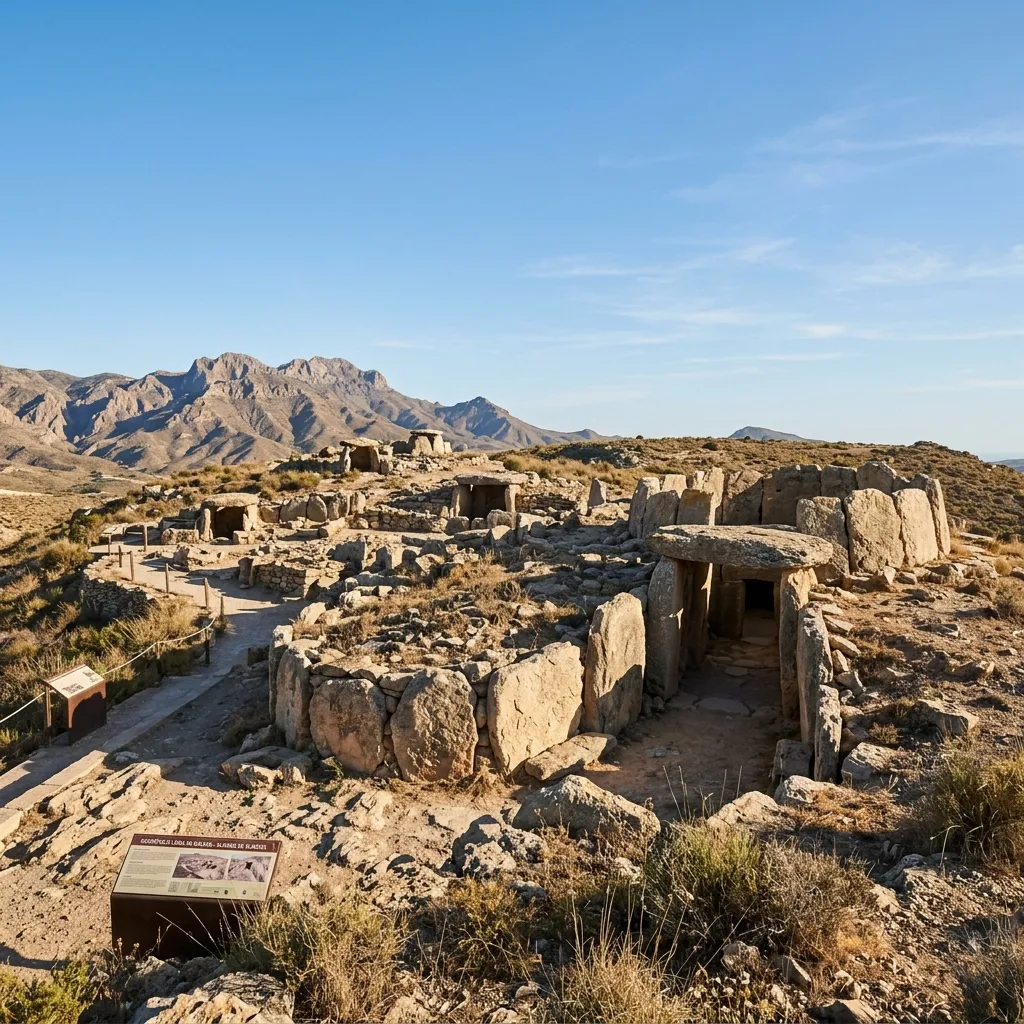
Facing the settlement lies a necropolis of about thirteen hectares with nearly eighty collective tombs. They are tholos: burial chambers of circular plan, three to six metres in diameter, covered by a false stone dome and topped by an earthen mound. They were reached by a corridor, and inside them bowls, idols and grave goods have been found that speak of the beliefs of those who built them. This Millares culture precedes and paves the way for the El Argar civilisation, which would dominate south-eastern Spain in the Bronze Age.
Documented in 1891, during railway works, and studied by the engineer Luis Siret | Reception and interpretation centre on site | Best to confirm opening hours and access before visiting.
Life in the citadel
Copper, pottery and water
Within the walls lived copper craftsmen, potters and farmers. Ore brought from the nearby sierra was smelted in furnaces to make axes, awls and tools; pottery workshops produced vessels and idols, and the fields of the Andarax valley, irrigated through an early mastery of water, fed a sizeable population.
That blend of metallurgy, irrigated farming and control of the routes made Los Millares a centre of power. Its size, its concentric walls and its network of forts have made it a reference of the European Chalcolithic and a model for understanding how the continent's first complex societies were organised.