Almond
The tree of the Andarax slopes and the Sierra de Gádor, dressing the Alpujarra in white in late January. In Alhama, the Los Frailes archives document its arrival on the old terraced plots.
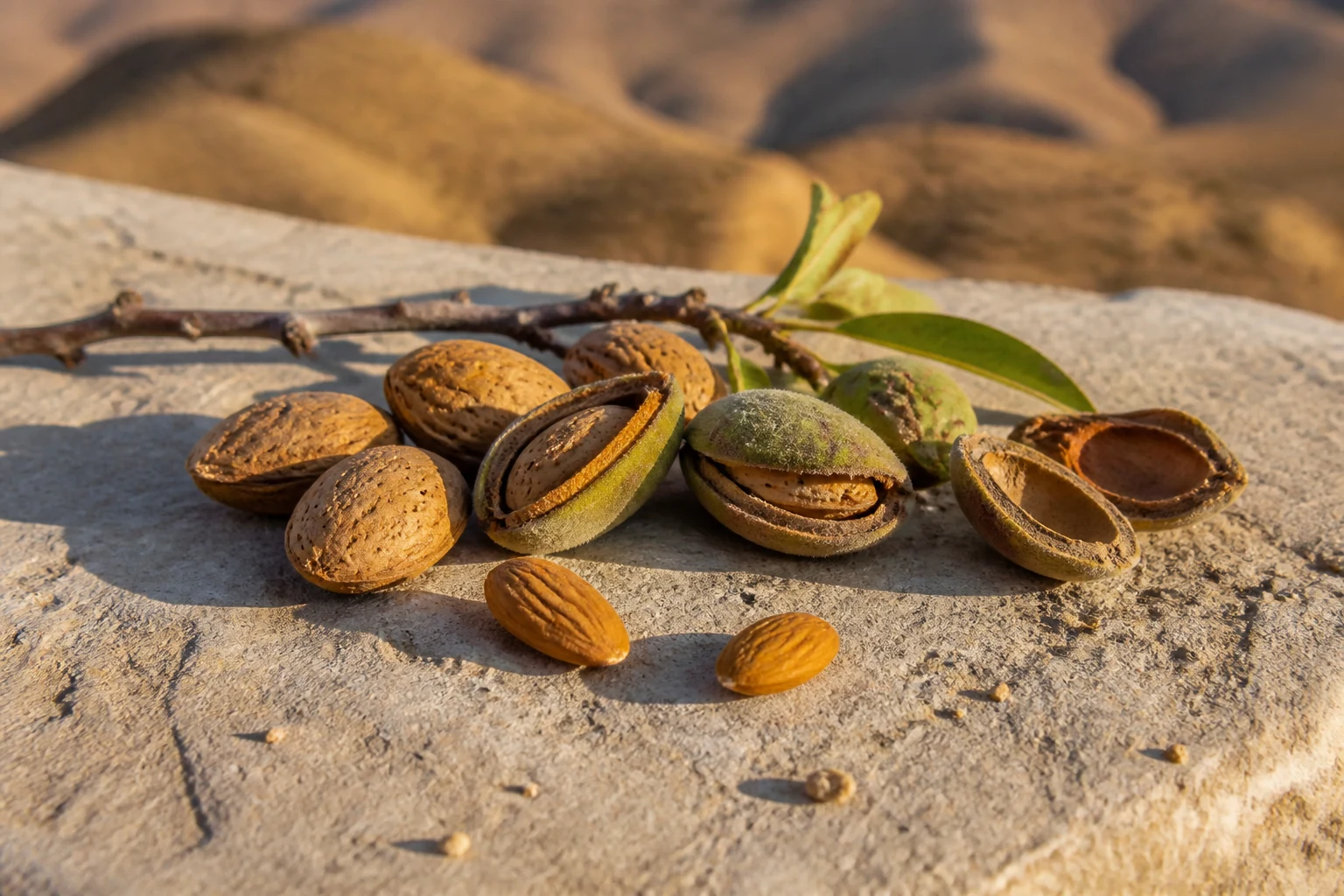
The almond is the nut of Alhama's terroir: the almond tree climbs the slopes of the Andarax valley and the Sierra de Gádor where the olive stops, and carries on to the high drylands of the province. It is a crop of patience — dry farming, pruning and waiting: across Andalusia, 84% of almond groves are still worked without irrigation — that Almería practises on a grand scale: more than 37,000 organic hectares according to 2026 sector data which, together with Granada, gather almost all of Andalusia's organic almond groves; Los Vélez and the Alto Almanzora alone count some 57,000 hectares. Provincial figures, not municipal ones: the bond with Alhama comes from the archives — at the Los Frailes estate, the almond tree arrived after the olives, the cereals and the parrales.
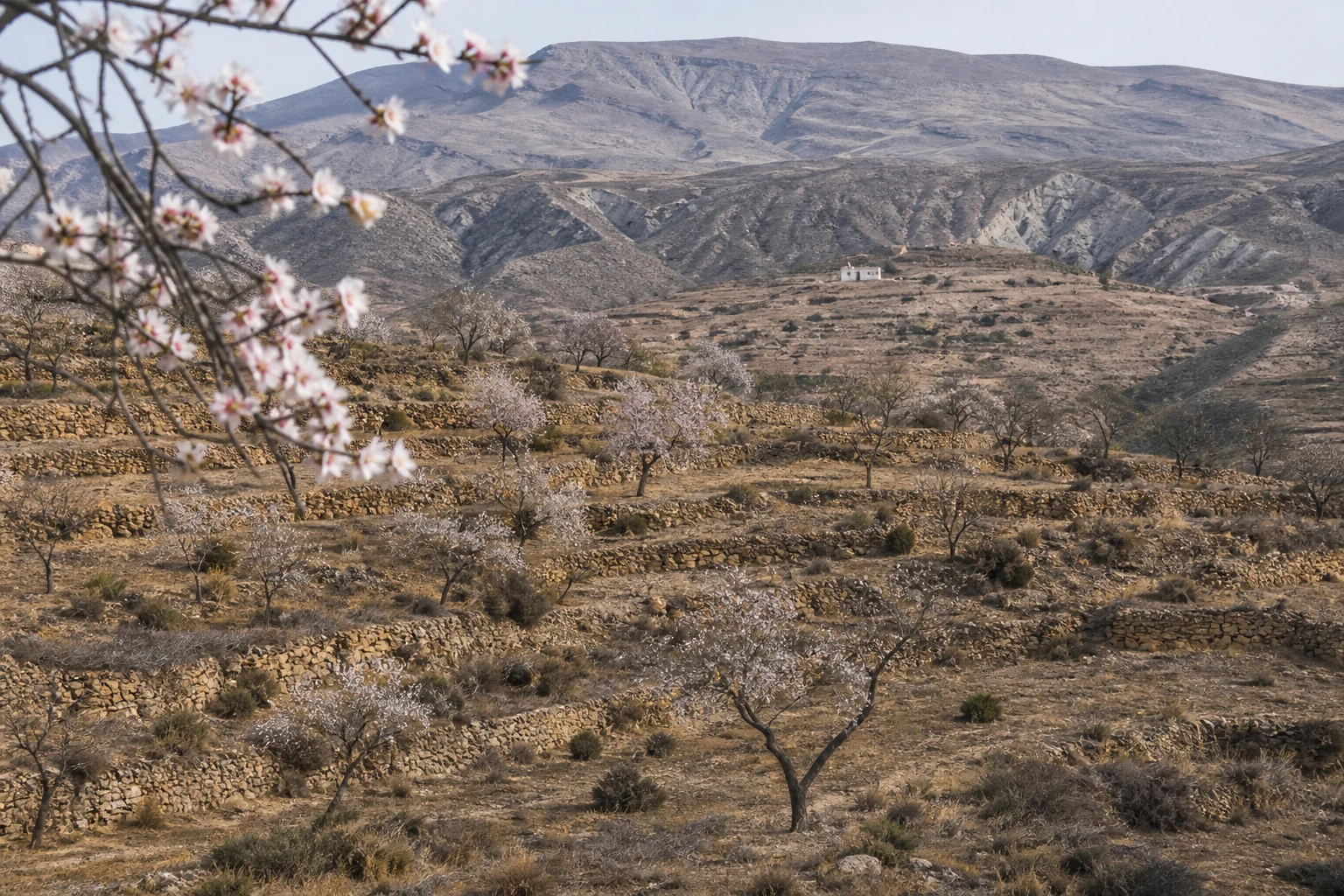
Its finest moment comes when no one expects it: between late January and February, the almond trees of the Alpujarra and of the hills around Alhama blossom white and pink in the middle of winter. It is one of the great reasons to visit the interior in low season — the hiking routes and the valley's viewpoints then look out over a snowfield of flowers.
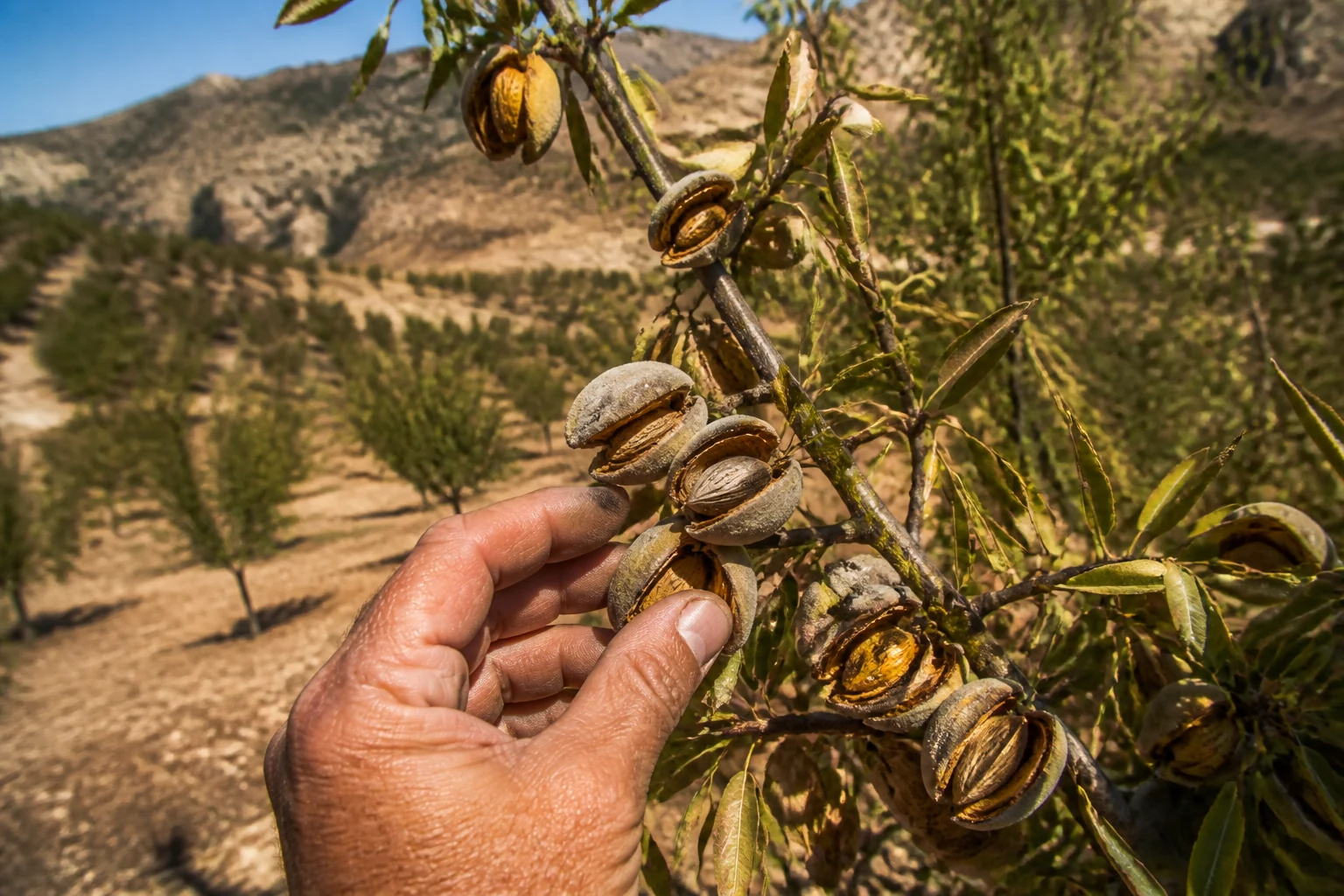
The harvest, though, belongs to summer's end: in August and September the trees are shaken and the almonds head for the pantry. The Guara rules many Andalusian drylands, alongside the Comuna, the Largueta and the Marcona, and recent plantings add late-flowering varieties that dodge the frosts — the names of a provincial varietal landscape, not a selection of Alhama's own. From the pantry come ajoblanco, the cold soup that turns the almond into a dish, and the almond sweets that run through all the pastry-making of the south-east.
Varieties
- Guara
- Comuna
- Largueta
- Marcona
- Late-flowering: Tuono, Ferragnès, Marta or Antoñeta
Season
Almond blossom on the dry terraces
At winter's end, scattered almond trees dot the mineral terraces of the interior with white and pale pink: low walls, ochre soil, sparse scrub and bare relief. The bloom moves with altitude — starting near the coast and climbing slowly towards the Alpujarra — and stays light, far from a postcard carpet.
An ancient tree, a dryland craft
The almond tree came from the East with the Phoenicians, and Romans and then Arabs kept it going on these slopes; the craft has barely changed. It is dry-farmed — the tree lives on whatever rain falls — pruning opens its crown to the light, and at summer's end poles knock the fruit down onto canvas sheets. Slow farming, a few practised gestures, much of it carried out organically on a large scale across the province.
On the plate
- → Almond ajoblanco
- → Soplillos
- → Mantecados de Laujar y Fondón
- → Turrón de Olula de Castro
- → Alfajores
- → Dulce del paraíso
- → Cuajao de almendras
- → Mostachones
- → Indalotes y lagrimicas de Santa Ana
- → Deditos de Jesús
- → Tortas de alfajor
- → Almendrados y roscos de aguardiente
- → Pan de higo
- → Carne al ajillo
- → Choto al ajillo
- → Miel de Almería
- → Talvinas